
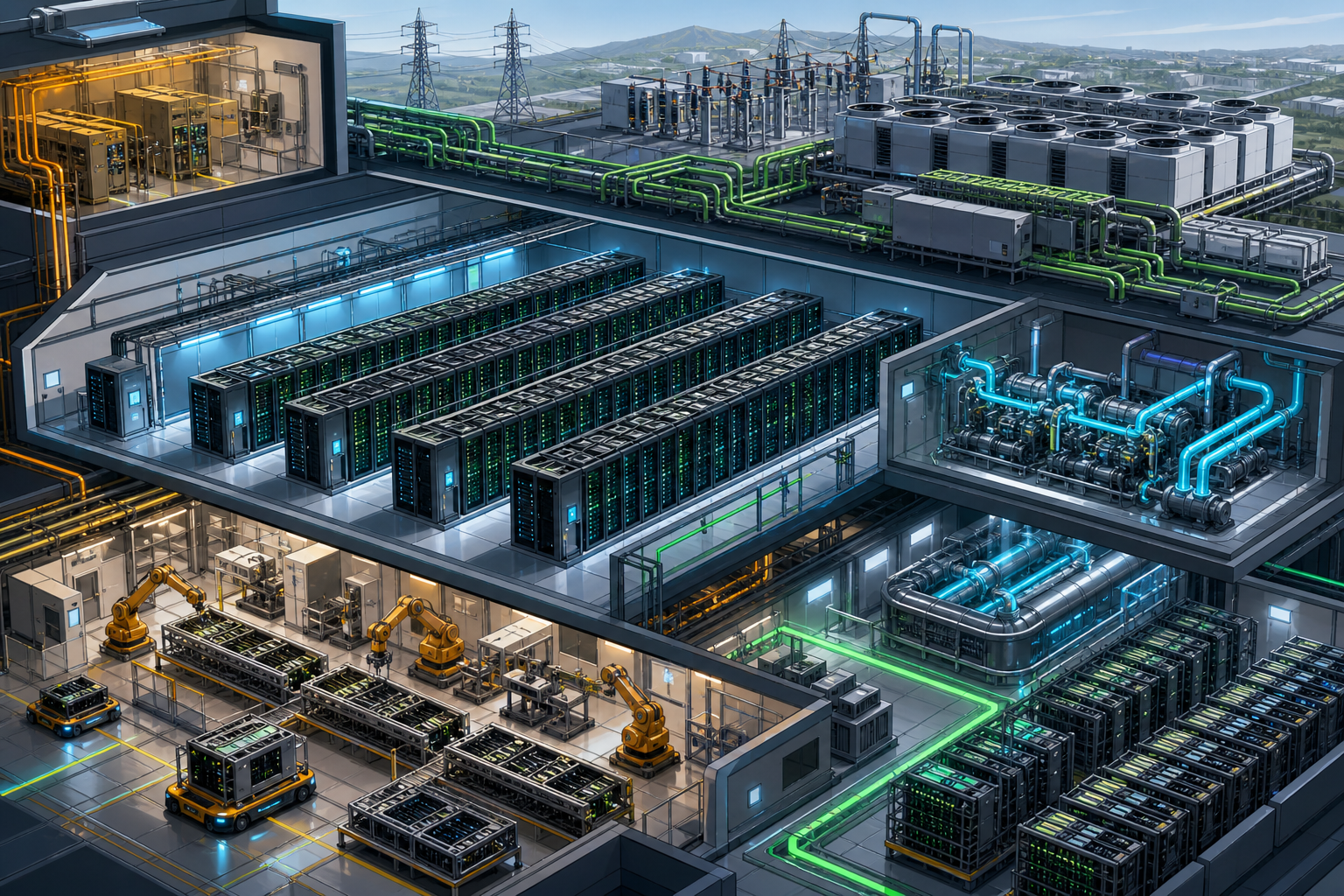
Schneider Electric and Foxconn are partnering to build AI data centers in the United States, Reuters reported on June 15. The deal is notable because the AI boom is increasingly constrained by physical infrastructure: power systems, cooling, manufacturing capacity, supply chains, and the ability to deploy large computing facilities quickly.
What Happened
Reuters reported that Schneider Electric, a major provider of energy management and automation equipment, is working with Foxconn, the electronics manufacturing giant, on AI data-center construction in the U.S. The partnership combines Schneider’s expertise in electrical infrastructure and power management with Foxconn’s manufacturing scale and experience producing complex electronics systems.
The announcement arrives as cloud providers, model developers, and enterprise customers race to secure capacity for training and serving AI models. Modern AI data centers require dense clusters of accelerators, high-throughput networking, advanced cooling, and reliable power distribution. Those needs have turned data-center infrastructure into one of the most important bottlenecks in the AI economy.
Why It Matters
For AI companies, access to compute is a strategic advantage. But compute is not only about buying GPUs. It depends on whether facilities can be designed, permitted, powered, cooled, and operated at scale. Partnerships like Schneider and Foxconn’s show that the competitive frontier is expanding from chips and models into industrial execution.
The U.S. focus also reflects policy and supply-chain considerations. Governments and companies want more critical AI infrastructure built domestically or in trusted jurisdictions. At the same time, data centers face scrutiny over grid capacity, water use, emissions, and local economic impact. Companies that can deliver faster and more efficient facilities may shape where AI workloads are physically located.
The AI Buildout Moves Into Heavy Industry
AI infrastructure is now a manufacturing and energy story as much as a software story. Data centers built for frontier AI can consume far more power per rack than traditional enterprise facilities, which makes electrical design and thermal management central to performance. Schneider’s role points to the importance of power distribution, backup systems, and energy efficiency, while Foxconn’s role points to modular manufacturing and rapid deployment.
For practitioners, the takeaway is that model availability and cost will increasingly depend on upstream infrastructure decisions. If new facilities come online quickly, inference prices and capacity constraints may improve. If power, cooling, or supply-chain limits persist, even strong models may remain expensive or rate-limited for some workloads.
Key Takeaways
- Schneider Electric and Foxconn are partnering on U.S. AI data-center infrastructure.
- The AI boom is creating demand for power, cooling, manufacturing, and deployment expertise.
- Infrastructure capacity is becoming a competitive factor for model providers and cloud platforms.
- Domestic data-center buildouts also raise policy, energy, and local-impact questions.
Source: Reuters