
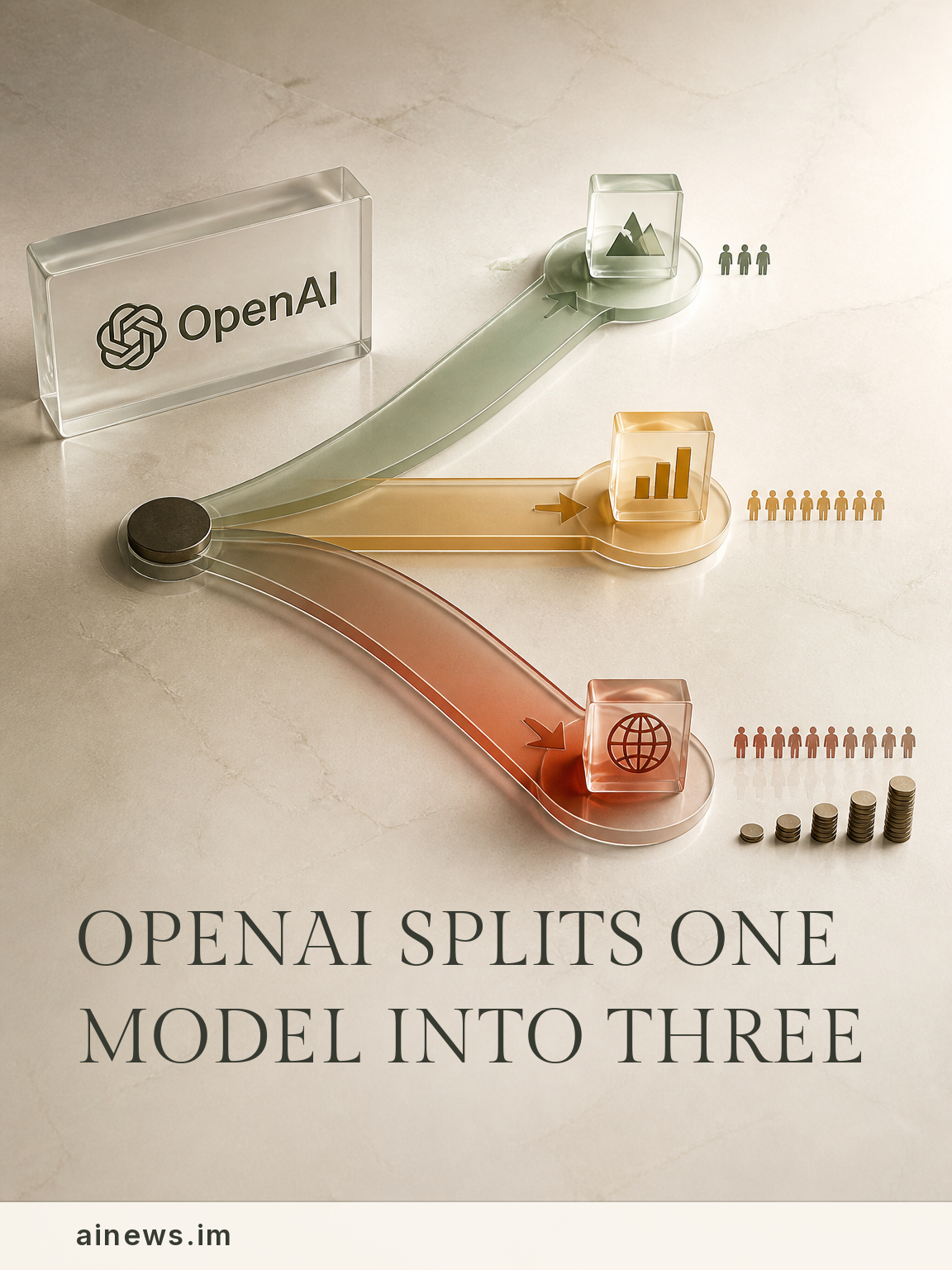
OpenAI just released GPT-5.6 in limited preview, and the strategy is clear: stop thinking of one model, start thinking of a portfolio built for real work.
Three tiers. Sol handles the hard reasoning tasks, the kind where you throw a 50-page legal contract or a quantum simulation at it and need answers that hold up. Terra handles your daily work. Code review, email draft, research summary, the stuff you do every single day. Then Luna, the lightweight version, is for bulk work at scale. Summarize ten thousand customer support tickets. Categorize a million images. The price is honest: you pay for what you use.
This is how you compete when someone is building chips just to run your model cheaper. You do not match their speed. You match their economics by building three versions instead of one. OpenAI spent the last six months shipping custom silicon with Broadcom. Now they are shipping custom models for custom use cases. One sits at inference time, the other at training time.
The limit right now is that GPT-5.6 is only available to a handful of partner institutions. But the pattern is set. If you want to win at inference, you build across the stack: cheaper chips, cheaper models, cheaper operations. Every tier pinches a cost somewhere. Sol is expensive to run but cheap to develop with. Luna is cheap to run but expensive to fine-tune. Terra is the bet on the middle.
Anthropic is watching this move. Google is watching this move. The model wars are not over. They are just moving from raw capability to real-world economics.
Book your free AI clarity call, NOW!
https://buff.ly/TpWy277
Sources:
https://www.buildfastwithai.com/blogs/ai-news-today-june-26-2026
https://aiweekly.co/alerts/openai-gpt-56-launch
https://venturebeat.com/ai
Repost this. Thanks.